
Oliver Sieber
(Imaginary Club, SkinsModsTeds, J_subs)
Photographer, curator, and publisher, Oliver Sieber has been involved in many different aspects of transmitting photographic culture. The common thread in all his activities is a fascination with young people’s individuality and identity, and an interest in the youth culture that is crucial in shaping them.
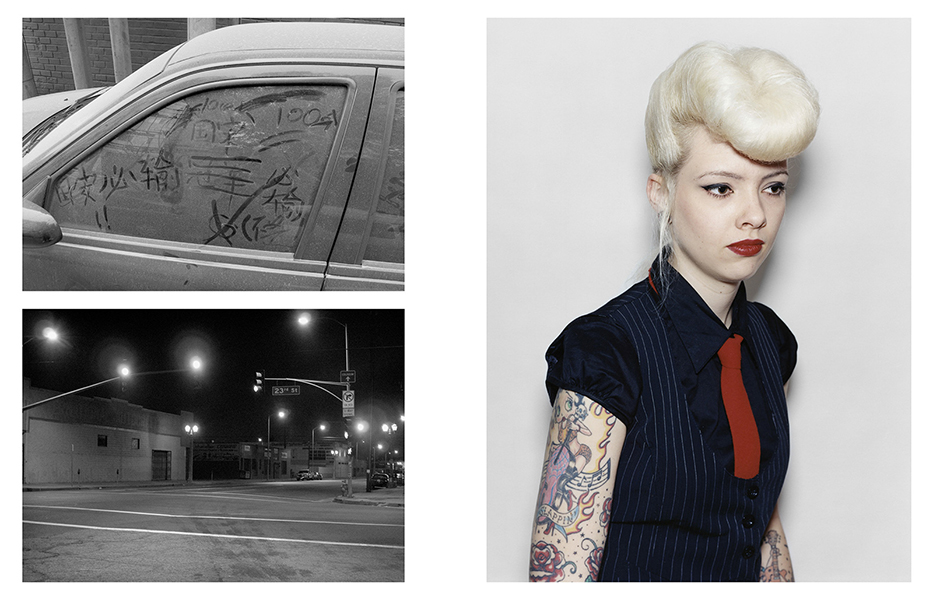
His best-known work, Imaginary Club (2013), is a collection of portraits taken in clubs around the world from Japan to Germany to America. Each subculture growing out of the music scene has its own individual style, and the clothing and hairstyles of these young people identify the masmods, punks, or members of some other tribe. What is striking is that all the mod- els are posed in the same way, looking off to the side of the camera, almost like a collection of pattern samples. The portraits emphasize how important music and fashion are for the identity formation of youth around the world. In this sense at least, the artist’s imaginary club is a real club.
These images bring to mind the photographer August Sander, active in Germany during the Weimar Republic, whose photographs of people of all classes, races, and occupations, highlighted social structures and had a great influence on later artists, most notably perhaps contemporary artists Bernd and Hilla Becher. In their work, photographs of the old structures that are the legacy of modern industrialization are displayed in a novel style that they call ‘typology,’ so named because they are grouped into ‘types’ according to the subject matter, thus turning the images into symbols, while at the same time both emphasizing individual differences and making the specimens appear as a unified whole.
Many artists of the Becher ‘school’—graduates of the Düsseldorf Art Academy where the Bechers taught—later turned their attention to architecture or the environment. But Sieber, who grew up in Düsseldorf, became fascinated by the dedicated attachment to the punk and mod subcultures that he witnessed among young people living there. His début work, SkinsModsTeds (1999), helped him establish his own creative style. J Subs, whose subject is Japanese subcultures, was made after Sieber participated in a 2006 exchange project between Osaka Prefecture and the city of Düsseldorf. This exhibition will be the first opportunity to see these two series and Imaginary Club presented in one place.
Content:
In panel/frame:
Imaginary Club
120 in 8 frames
SkinsModsTeds
55 images in projection
J_subs
66 framed
Participation Fee:
Please contact us. The host venue is also responsible for the exhibition design costs, pro-rated shipping and insurance.
Availability:
The exhibition is available through 2018.