
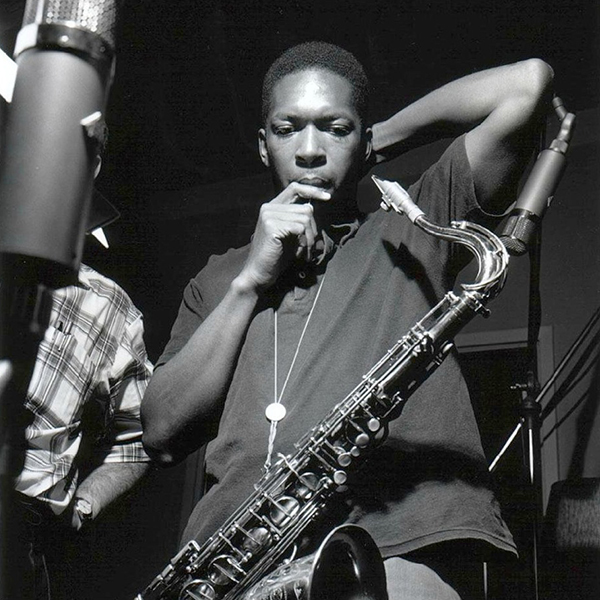
Francis Wolff
(Selection from “A Vision of Jazz the 2015 KYOTOGRAPHIE Exhibition”)
Blue Note Records rose to fame in New York City, releasing masterpieces of modern jazz by performers such as Jimmy Smith, Miles Davis, Thelonious Monk, and Art Blakey, yet the label was created by two virtually unknown refugees from Nazi Germany, founder Alfred Lion and his business partner, Francis Wolff (1907–1971),who was also the company’s resident photographer. Lion,a working-class man who was far from wealthy, made his first recording in 1939 without thinking much of the consequences. Wolff made his way to the city the same year.
Lion and Wolff were both blown away by the jazz music that was popular in 1920’s Berlin, where they had spent their younger days together. Wolff’s photography, taken up with his mother’s encouragement, clearly exhibits the influences present in 20’s and 30’s Berlin, where trends in photography were transitioning from the New Objectivity to the New Photography movement.
It also should not be overlooked that New York is a place where great advances were made in the fields of photography and graphic art during the 40s and 50s, nor that the key figures working in those fields, like Wolff, were often diasporic immigrants and refugees. For example, the art director of Harper’s Bazaar, Alexey Brodovitch, and the art director of Vogue, Alexander Liberman, were both refugees escaping the upheaval of the Russian Revolution, and Martin Munkacsi, who established a new form of photography with his dynamic outdoor photographs, was a Hungarian Jew.
Wolff made a living as a photographer after arriving in the United States, documenting Blue Note Records’ live performances and recording sessions. Wolff masterfully translated the allure and atmosphere of jazz, zeroing in on each performer by eliminating the superfluous from his photographs,which overflow with a sense of modernity, captivating fans of both jazz and photography a like.Reid Miles (1927–1993),who designed jackets for the majority of the albums released at the peak of Blue Note Records’ popularity, had a talent for incorporating typography in bold designs, and was also undoubtedly influenced by the New York scene during those years.
In this exhibition, a visual archive of Wolff’s 50s and 60s-influenced photographs, together with Miles’ designs, makes its way to Japan for the first time. Along with the original photographs used to create the label’s iconic album jackets, the extremely valuable contact sheets, offering a clearer view of Wolff’s unique perspective, are also a must-see.
—Hitoshi Namekata (editor-in-chief). Yamaha Music Media, 2014. Note: Blue Note: Uncompromising Expression. Richard Havers (author),
Content:
Panel: 40 images in two sizes mount
(23) 500×500
(17) 1000×1000
Contact sheet: 17 sheets at 1000×1300
Cropped image:
(4) 500X500
Accompanying Books:
Participation Fee:
Please contact us. The host venue is also responsible for the exhibition design costs, pro-rated shipping and insurance.
Availability:
The exhibition is available through 2018.